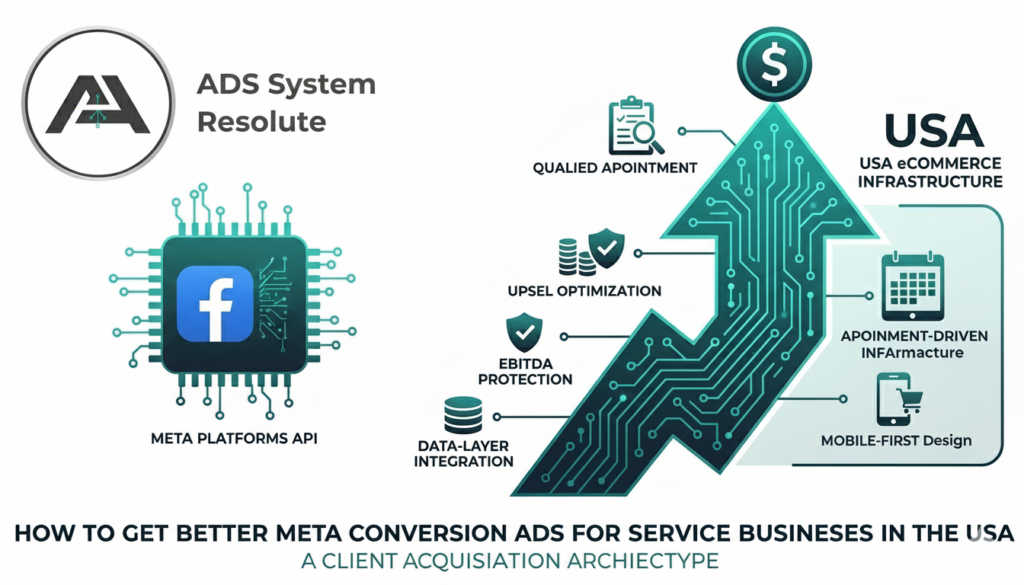
Scaling a service-based business in the competitive USA market using Meta (Facebook and Instagram) requires a fundamental shift in strategy. Unlike eCommerce, where success is often measured by immediate return on ad spend (ROAS), service businesses must focus on creating a robust Client Acquisition Architecture. To obtain Better Meta Conversion Ads, the objective must move beyond simply generating leads to establishing a system that attracts high-intent prospects and streamlines the path to a qualified appointment.
1. Defining Success: Volume vs. Quality in USA Service ADS
A primary challenge for service businesses on Meta is optimizing for the correct metric. While a low Cost Per Lead (CPL) may seem attractive, it often results in a high volume of unqualified prospects. In the USA, where lead generation costs are high, success is more accurately measured by the Cost Per Qualified Appointment (CPQA).
- Pre-Qualification Strategies: Better conversion ads for services do not just attract; they disqualify. The ad creative and subsequent funnel must do the heavy lifting of establishing authority and addressing common objections before the prospect requests a consultation.
- The USA Auction Dynamics: Meta’s algorithm prioritizes user value. To win placement in the competitive USA auction, Conversion ADS must signal high relevance, which is achieved through precise targeting and a frictionless user experience.
2. Structural Velocity: The Importance of a High-Performing Funnel
The effectiveness of any Meta ad campaign is limited by the quality of the destination. For service businesses, this means the landing page or booking experience must be optimized for speed and clarity. We define this imperative as Structural Velocity.
- The Psychology of Friction: Every additional step or slow-loading element on your booking page is a point of friction that increases your Meta ADS CPA. A potential client in the USA, often accessing the site via a mobile device, will abandon a process that is not seamless.
- Optimization Frameworks: Implementing a streamlined, calendar-based booking system directly on the landing page reduces the steps from interest to appointment.
3. The Three Technical Pillars of Superior Meta Conversion ADS
- Pillar 1: High-Intent Creative: Video content that establishes authority and addresses specific pain points outperforms generic imagery.
- Pillar 2: Signal Resilience (Conversions API): Feeding server-side events, like a “qualified appointment” status, directly to Meta allows the algorithm to learn from business outcomes, not just surface-level clicks.
- Pillar 3: Intent-Based Filtering: Whether using Native Forms or Landing Pages, implement qualifying questions to ensure that only prospects with genuine intent progress to the scheduling phase.
4. Strategic Retargeting: Building Authority Beyond the Initial Click
Most service businesses underutilize retargeting. Instead of showing the same ad, use retargeting to deepen the relationship.
- Sequential Messaging: Serve content that addresses objections or showcases case studies to prospects who visited the booking page but did not convert.
- Cross-Channel Synergy: Utilize engagement data to inform broader acquisition strategies, ensuring the prospect remains nurtured throughout the decision-making cycle.
The Fundamental Constant: ADS Decision-Making
Regardless of the technological evolution of platforms like Meta, the core pillars of advertising have not changed. The ability to read value-based metrics, make data-driven decisions, and—most importantly—interpret the nuances of buyer behavior remains the ultimate competitive advantage. While tools and algorithms update, the logic of market psychology and the rigorous analysis of what drives a profitable acquisition remain the definitive keys to scaling any service-based business.