
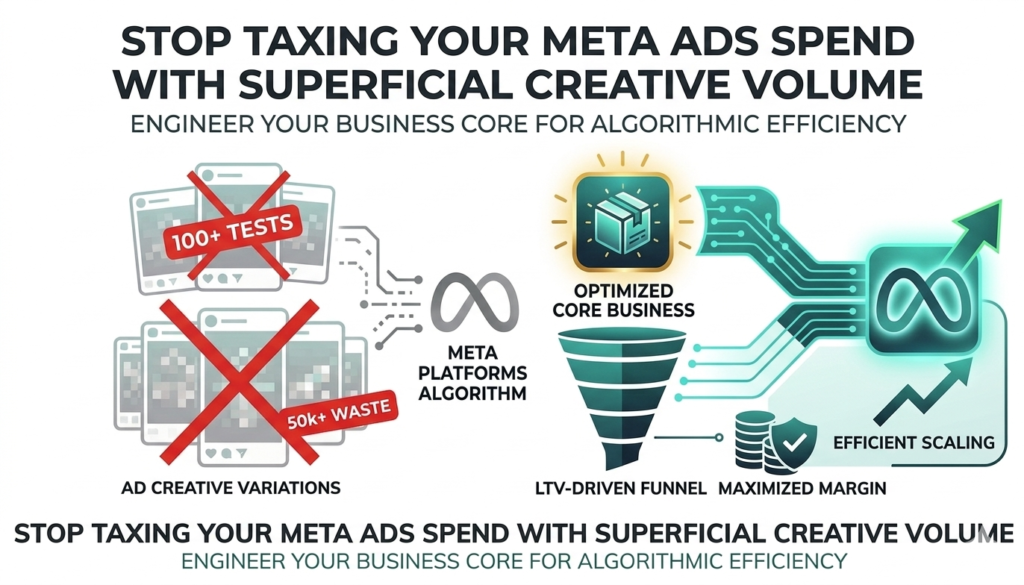
For years, the standard approach to scaling Meta ADS has been defined by creative volume. The prevailing logic dictates testing hundreds of variations to find “winners,” often leading to massive expenditure—sometimes exceeding $50,000 in testing alone—with diminishing returns. Today, a new paradigm is emerging: successful scaling requires moving beyond superficial creative iteration and focusing on profound Core Business Optimization. When your product, margin, and funnel are fundamentally engineered for a high Lifetime Value (LTV), the Meta algorithm requires less data and capital to perform its job efficiently.
1. The Myth of Creative Volume: Why High-Spend Testing is a Capital Tax
A common misconception in the eCommerce sector is that the algorithm can solve every inefficiency through diverse creative inputs. In high-stakes auctions like the USA, this approach is a “capital tax.” Excessive testing without deep strategic logic increases the complexity of the Meta ADS System, forcing the algorithm to distribute budget across hundreds of assets that often suffer from data fragmentation.
- Capital Fragmentation: Spreading a testing budget too thin prevents any single asset from accumulating sufficient data to pass the algorithm’s learning phase.
- The Margin Problem: No amount of creative ingenuity can compensate for an insufficient gross margin or a weak product/market fit. The algorithm will find customers, but if the internal economics of the transaction are weak, the operation is unsustainable.
2. Core Business Excellence: The Foundation of Efficient Meta ADS
To allow Meta to operate with maximum efficiency, you must focus 100% of your initial engineering effort on the business core. A fundamentally excellent product or service creates its own momentum, allowing the ADS to serve as an accelerator, not a crutch.
The Psychology of Value-Based Optimization
Just as McDonald’s doesn’t build its empire on the complexity of its burger but on the efficiency and margin of its entire system, your eCommerce strategy must be built on value-based optimization. This means prioritizing deep Data-Layer Integration to feed accurate value signals back to the Meta algorithm. When Meta knows not just who converted, but the true monetary value and LTV probability of that conversion, its bidding behavior becomes profoundly more precise.
3. Structural Velocity: Aligning the Funnel with LTV Engineering
Meta ADS perform when the signal is strong. To strengthen that signal, your eCommerce architecture must be engineered for Structural Velocity. This means maximizing the efficiency of every session.
- Funnel and Margin Synergy: Every element, from the Mobile-First Resolute Design to the Appointment-Driven Infrastructure, must be aligned to maximize the Average Order Value (AOV) and LTV. When the algorithm identifies high-margin users who repeat their purchases, the Resolute “Fries” Protocol (Upsells/Cross-sells) ensures that the initial acquisition cost is rapidly amortized.
- The Easy Path for Meta: When Meta is given traffic that is primed to convert due to optimized UX and strong product logic, its job becomes simple. It doesn’t need 100 creatives to find a buyer; it only needs data to identify the predictable pattern of a winning transaction.
4. Strategic Conclusion: Turning ADS from a Variable Cost into an Investment
Scaling with Meta in a mature market requires a decision: continue feeding the creative machine or begin engineering the business core. By prioritizing Structural Speed, Value-Based Metrics, and a profound understanding of Buyer Behavior, businesses can transform ADS spend from a recurring variable expense into a strategic investment. Stop taxing your business with surface innovation and start investing in the infrastructure that makes the algorithm work.