
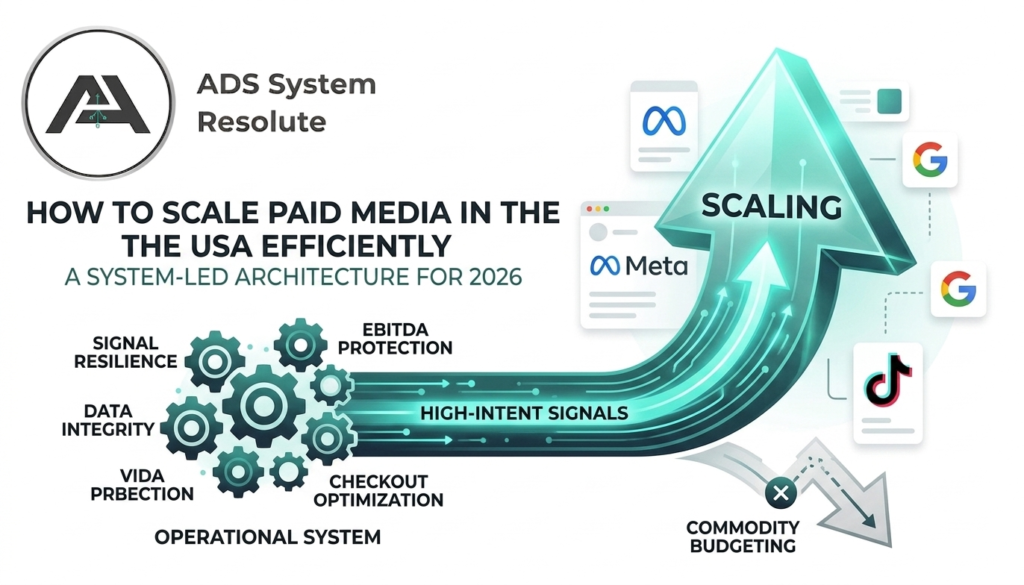
Scaling paid media in the USA in 2026 is no longer a matter of “increasing budget and hoping the algorithm follows.” The American advertising ecosystem is characterized by extreme signal fragmentation (iOS 17+, advanced privacy layers, modeled conversions), hyper-volatile auctions driven by predictive AI, and creative fatigue cycles that are shorter than ever. In this environment, the highest advertising spend does not guarantee market share. The competitive advantage in 2026 belongs to the operator who controls the integrity and density of the data signals feeding Meta, Google, and TikTok.
“You do not scale ads. You scale the operational system that feeds the ads.”
⭐ 1. The New Scaling Paradigm: Signal Density vs. Budget Expansion
In 2026, algorithmic optimization is predicated on data probability. Platforms like Meta and Google are not looking for budget; they are looking for predictive behavioral patterns. They optimize for:
- High-Intent Buyers: Users with a documented probability of conversion.
- Consistent Post-Click Behavior: Frictionless journeys that validate the initial ad signal.
- Stable Conversion Signals: A resilient data stream (via Conversions API/Server-Side) that minimizes modeled guesswork.
If your data signals are weak, doubling your budget merely doubles the algorithmic chaos, leading to rapid CPA inflation.
Operational Rule: “Achieve Signal Resilience and directional consistency before executing budget expansion.”
⭐ 2. The 2026 Scaling Architecture (USA Market)
Successfully scaling in the high-CPM USA auction requires a consolidated infrastructure designed for machine learning efficiency.
A. Consolidated Account Structure (Signal Congruence)
Algorithm learning thrives on data density. Fragmentation kills performance.
- Axiom: Fewer campaigns equate to more data points per learning unit.
- Structure: 1–2 Core Acquisition Campaigns, 3–5 specialized Ad Sets, and 3–6 active Creative Assets.
- Constraint: Eliminate unnecessary duplication or granular targeting that dilutes signal density.
B. Creative Velocity and Contextual Bidding
The creative fatigue cycle in the USA is accelerated by aggressive competition and audience saturation.
- Creative Mandate: A rigid creative rotation is required every 5–7 days.
- Kill Switch: If a creative asset does not generate at least 1 conversion per 1,000 impressions, it is deactivated immediately. Creative failure in 2026 is an infrastructural failure.
C. MER-First Scaling (Macro-Efficiency)
ROAS (Return on Ad Spend) is often a siloed, misleading metric. MER (Marketing Efficiency Ratio) is the definitive metric for business stability.
- Scaling Triggers: Budget expansion is only executed when:
- MER remains stable for 7 consecutive days.
- CAC (Customer Acquisition Cost) does not inflate by more than 12%.
- Post-click conversion rates remain steady.
D. Micro-Scaling (The 20% Rule)
Large budget jumps shock the algorithmic learning phase. The high-volume USA auction requires Micro-Scaling.
- Execution: Implement budget increases of 20–30% only.
- Cadence: Every 48–72 hours, provided the scaling triggers (MER/CAC) remain green. Never execute 100% budget jumps.
⭐ 3. The 2026 Paid Media Operational Loop
The modern scaling operator adheres to a strict, non-negotiable optimization cycle:
- Creative Testing (Micro-Batches): Validate creative hooks with minimal spend fragmentation.
- Signal Stabilization (Checkout & Server-Side): Ensure the pixel and API are receiving clean, high-intent data.
- Scaling Window Detection (7-Day Trend): Identify consistent performance outside of daily volatility.
- Budget Expansion (Micro-Scaling): Execute the 20–30% increase.
- Creative Refresh: Anticipate fatigue; deploy pre-validated creatives before performance dips.
- EBITDA Protection Check (MER & CAC): Audit the impact on net margin.
“If a single step in the loop fails, budget expansion is halted.”
⭐ 4. USA Scaling Case Study (2026 Analysis)
- Vertical: Premium Stress-Relief Supplement (DTC, USA)
- Unit Economics: Price: $49 | AOV: $62 | Gross Margin: 68%
- Platform: Meta Ads (Advantage+ & Manual Hybrid)
- Baseline: $350/day
- Objective: Scale to $2,000/day while protecting CAC.
Phase 1: Signal Stabilization
- Metrics: MER: 2.8 | CAC: $31 | 4 Active Creatives.
- Audit: Server-Side API confirmed active. Checkout frictionless. Pixel signal clean.
- Action: Hold. Awaiting 7 days of directional consistency.
Phase 2: First Scaling Window
- Metrics: MER: 2.7 | CAC: $33. Consistency achieved.
- Action: Execute Micro-Scaling (+20% every 48h).
- Progression: $350 → $420 → $504 → $605/day.
Phase 3: Creative Fatigue Management & Scaling
- Metrics: MER: 2.6 | CAC: $35. Primary creative shows early signs of fatigue (CTR dip).
- Action: Deploy Pre-Validated Creative (2 new assets) + Micro-Scaling (+20% every 72h).
- Progression: $605 → $726 → $871 → $1,045/day.
Phase 4: Scaling Ceiling Detection
- Metrics: MER: 2.4 | CAC: $38. CPM inflating due to auction competition. Creative winners have fully fatigued.
- Action: Halt Scaling. Re-enter testing phase.
Final Outcome
- Result: Scaled from $350/day to $1,200/day (Stabilized). CAC was controlled, MER remained profitable, and the account infrastructure was preserved.
⭐ 5. The 3 Levers of Structural Scaling
To scale efficiently in 2026, you must manipulate the infrastructure, not just the budget.
Lever 1: Creative Density
More validated creatives create a denser data signal, which provides algorithmic stability.
- Requirement: Deploy 3 new, pre-validated creative assets per week.
Lever 2: Conversion Funnel Engineering
If the post-click experience (landing page, checkout) does not convert, you are feeding the pixel “garbage data,” training it to find low-intent users.
- Impact: Funnel optimization typically yields a 12% to 22% reduction in CAC.
Lever 3: First-Party Data & Audience Synergy
Relying solely on “cold” algorithmic prospecting is capital-intensive. Efficient scaling requires leveraging First-Party Data and Omnichannel Synergy.
- Scaling Sources: Use email engagement segments, SMS lists, post-purchase loops, and UGC-to-Ads synchronization to create high-integrity seed audiences for retargeting and Lookalikes.
⭐ 6. The 2026 Scaling Threshold
Do not execute budget expansion until the following conditions are met (The Resolute Checklist):
- [ ] MER: Stable for 7 days.
- [ ] CAC: At or below profitability target.
- [ ] Creative: At least 2 active “winners” with low fatigue.
- [ ] Signal: Conversions API and Pixel health validated.
- [ ] Funnel: Checkout friction minimized; Mobile UX optimized.
“If any box is unchecked, budget expansion is a capital tax, not an investment.”
⭐ 7. Final Insight: Scaling is a Data Discipline
The era of scaling paid media through intuition, audience “hacks,” or brute-force budget increases is over. Scaling in 2026 is a rigorous discipline of Data Engineering, Signal Integrity, and Operational Stability. You are not just buying impressions; you are building a predictable, algorithmically efficient machine.
“You do not scale ads. You scale the system that feeds the ads.”