
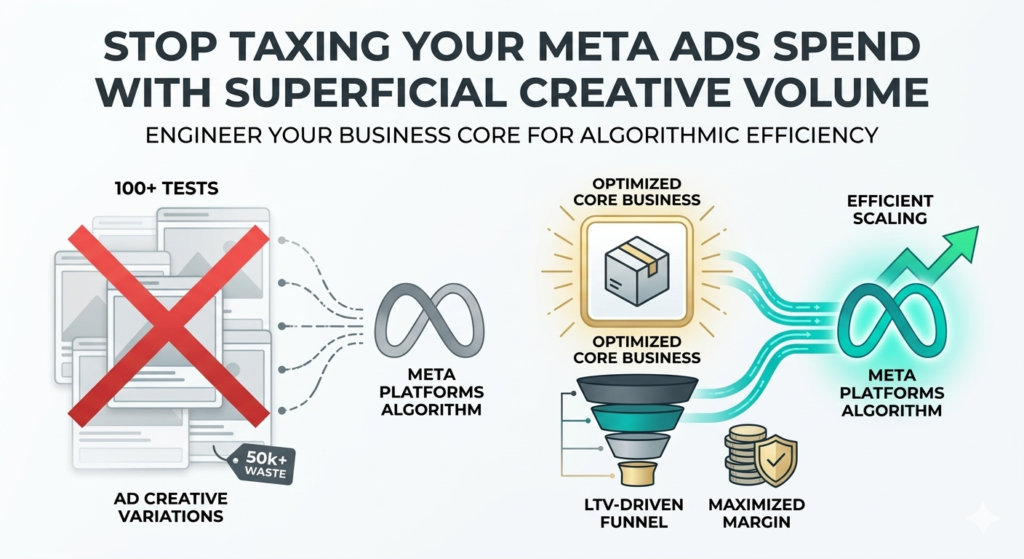
In the current digital landscape, there is a pervasive obsession with real-time data. High-growth eCommerce and service-based businesses in the USA often invest thousands in dynamic reporting dashboards, believing that “instant information” equates to “instant optimization.” However, the reality of 2026 shows a different pattern: approximately 90% of online businesses do not need constant data updates when there is no structural action to take. For these businesses, a robust, Upgraded SOP (Standard Operating Procedure) is a significantly more profitable asset than a dynamic dashboard.
1. The Reporting Trap: Information Overload vs. Operational Action
Dynamic reporting often creates a “false sense of control.” While seeing real-time fluctuations in CPA or ROAS is visually engaging, it rarely leads to better decision-making. In fact, it often triggers emotional, premature adjustments that reset algorithm learning phases.
- Data Without Context: A dashboard tells you what is happening, but an Upgraded SOP tells you when and how to react.
- The “Noise” Tax: Constant monitoring of stable campaigns leads to “tinkering,” a behavior that costs US businesses millions in lost algorithmic efficiency every year.
2. The Stabilizer Format: Why Advanced SOPs are More Profitable
An Advanced SOP acts as an operational stabilizer. Instead of reactive management based on the last 24 hours of data, a structural procedure dictates actions based on statistically significant windows.
| Feature | Dynamic Reporting | Upgraded SOP (The Stabilizer) |
| Focus | Observation (Passive). | Execution (Active). |
| Decision Trigger | Real-time volatility. | Pre-defined Performance Thresholds. |
| Impact on Margin | High overhead / Low ROI. | Low maintenance / High Scalability. |
| Algorithmic Health | Frequent resets (Negative). | Stability & Patience (Positive). |
Practical Example: The 72-Hour Rule
While a dashboard might show a “bad morning,” an Upgraded SOP prohibits any change until a 72-hour window is completed. This prevents the “panic-editing” that destroys Meta and Google’s predictive modeling.
3. Engineering the “Set and Forget” Infrastructure
The goal of a high-level business is not to watch ads, but to build a system where ads are a predictable utility. For most eCommerce and service businesses, the data doesn’t change enough daily to justify the “dashboard tax.”
- SOP-Driven Bidding: Instead of manual adjustments, use SOPs to define clear “If/Then” scenarios for automated rules.
- Structural Efficiency: By standardizing the response to data, you remove the “expert dependency.” The system becomes the expert, allowing for easier scaling of the operational team.
4. Why 90% of Businesses are Over-Reporting and Under-Executing
In the USA market, complexity is often mistaken for sophistication. A service business or a mid-market eCommerce brand doesn’t need a Wall Street trading floor setup. They need a Resolute Operational Blueprint that ensures that when a metric moves outside of a defined “Safe Zone,” the corrective action is immediate, documented, and unemotional.
- Value over Volume: Focus on the metrics that define your EBITDA, not the metrics that look good on a graph.
- The Profitability of Silence: Often, the most profitable action in advertising is to do nothing. An SOP provides the confidence to remain silent while the algorithm works.
The Fundamental Constant: Systems Over Statistics
In the end, the importance of advertising infrastructure has not shifted. The ability to read value-based metrics remains vital, but the Standardization of the Response is the true key to high-margin scaling. Decisions based on buyer behavior patterns, rather than hourly data spikes, remain the only way to build a long-term asset. Technology changes, but the profitability of a well-executed Standard Operating Procedure is permanent.
Nota Técnica para SEO: Este post utiliza el concepto de “Stabilizer Format” y “Operational Action” para atraer a dueños de negocio que se sienten abrumados por la data pero no ven resultados en su margen neto.
Real-World SOP Example: Scaling Logic for High-Ticket Services (USA)
- Niche: Lead Generation for Premium Home Services (HVAC/Solar).
- Trigger: Ad Set maintains a CPQA (Cost Per Qualified Appointment) 15% below target for 7 consecutive days.
- Execution (3 Steps):
- Horizontal Scale: Duplicate the winning Ad Set into a new “Scale Campaign” with a 30% higher budget; do not touch the original.
- Creative Hardening: Deploy the top-performing video hook into a “Lookalike 1-3%” audience to test signal resilience.
- Data Feedback Loop: Log the 7-day average CPA into the CRM to update the LTV Projection Model, ensuring the margin remains protected before the next budget hike.
Strategic Conclusion: The Stability of Systems vs. The Chaos of Data
Ultimately, the choice between a dynamic dashboard and an Upgraded SOP is a choice between reaction and control. While a dynamic system often provides an illusion of transparency, it frequently lacks the operational control necessary to scale.
An advanced SOP-driven model does more than just monitor; it provides a Business Stability Framework. It builds a resilient Scaling Infrastructure based on value-driven data and predictable human behavior. By standardizing how your organization interprets and reacts to performance, you move from a “reactive state” to an “executive state.” In the high-stakes USA market, the winner is not the one who sees the data first, but the one who has the most disciplined Infrastructure of Value to act upon it.